[Majorityrights Central] Three possible forms of a Ukrainian victory ... and a Russian defeat Posted by Guessedworker on Thursday, 16 April 2026 16:36.
[Majorityrights Central] Empires, the Chinese Mind, a theoretical nationalism of ethnicity Posted by Guessedworker on Saturday, 14 February 2026 01:54.
[Majorityrights News] Moscow Times: Valdai residents report no sign of drones attacking Putin residence Posted by Guessedworker on Tuesday, 30 December 2025 11:33.
[Majorityrights Central] Thoughts on Mark Collett’s strategy for nationalism in the British future Posted by Guessedworker on Friday, 24 October 2025 15:01.
[Majorityrights Central] Principles, parts, processes of ethnic nationalism, Part 1: inflection? Posted by Guessedworker on Thursday, 31 July 2025 12:03.
Visigrad Post, “Orbán: Brussels Must be Halted, and Hungary Must Stand Up Against International Capital”, 24 March 2017:
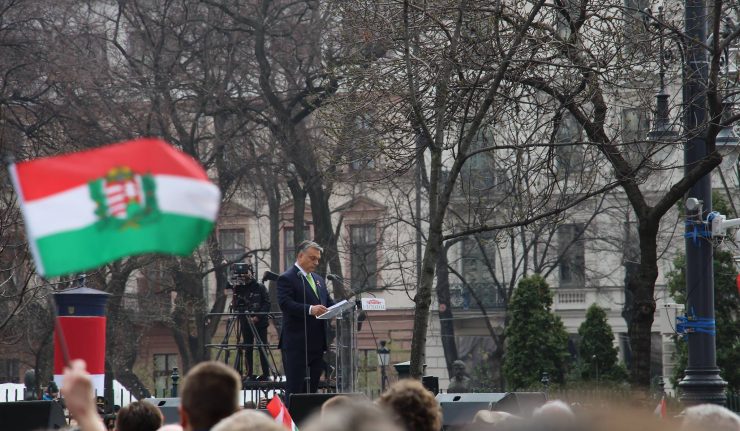
Hungary – Prime Minister Viktor Orbán called March 15 an “indisputable proof” of the Hungarian nation’s past, present and future, at a commemoration of the 1848-49 revolution and freedom fight on Wednesday, March 15.
Speaking in front of the National Museum, the prime minister said that European nations are in a “state of revolt”, with the “winds of 48 blowing again on the continent”. Over the past years European nations once again revolted against “the hypocritical alliance of the Brussels bureaucrats, the liberal international media and the insatiable global capital,” Orbán said.
First the British, then the Americans rebelled, to be followed by others this year, he added. Orbán stressed the need for Brussels to take off the “masks of hypocrisy”, and opt for straight speech and an open discussion of the future.
Orbán emphasised that the resettlement of illegal migrants must be prevented, the network financed from foreign funds made transparent, and the right to regulate taxes, wages and utility prices kept in national competence.
Orbán called March 15 an “indisputable proof” of the Hungarian nation’s past, present and future. “We, living in the Carpathian Basin, at the buffer zone of cultures, empires and civilisations, can be proud of the greatest triumph of all, winning all wars for the survival of our homeland, our nation,” he said.
He said 1848 had become a “moral compass” for the nation, one that shows who is “loyal, patriotic, dedicated and brave” on the one hand, and exposes “pettiness, perfidy and efforts to kill dreams and destroy the nation” on the other. The prime minister insisted that national unity should be retained and cemented day by day.
“But what should we do with those who want unrest and division rather than peace and unity . whose only pleasure lies in spoiling the holiday of others,” he asked, referring to a group whistling during his speech. “It would be easy to mock them but we should not do that,” he said adding that Hungarians should “stand their ground on the horizon of building the nation rather than in the skirmishes of petty parties.”
“From the horizon of the Hungarian nation, one can choose the road that leads us to the wide gate of greatness or the one that leads to the swamp of hatred,” he said.
Posted by DanielS on Thursday, 23 March 2017 04:59.
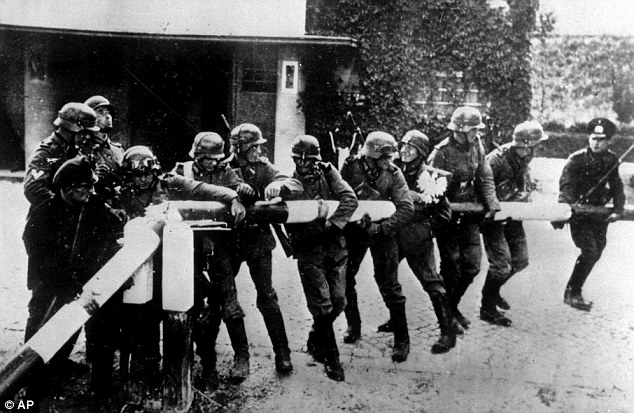
Nazis dismantling Polish border control.
Breitbart, “EU Says They Can Force All Members, Including Poland, to Take Migrants”, 21 March 2017:
WARSAW, Poland (AP) — The European Union’s commissioner for migration says there are ways to make all EU members states comply with the program of relocation of migrants among them.
Dimitris Avramopoulos made the statement Tuesday in Warsaw, where he is visiting the growing European border guard agency, Frontex.
Poland is refusing to accept migrants, arguing they are chiefly economic migrants, not war refugees, and may potentially pose a threat.
The relocation plan is intended to ease the pressure on countries that have taken the brunt of the migrant wave: Italy and Greece.
Without naming Poland, Avramopoulos said the EU has the “tools, the means and the power” to convince all members to comply and will make an assessment of response by the end of September. He mentioned no sanctions.
Since 1 November 2014 he is serving as EU Commissioner for Migration, Home Affairs and Citizenship in the Juncker Commission.
Avramopoulos has a friendly relation with the Turkish President Recep Tayyip Erdoğan since they were Mayors of Athens and Istanbul respectively. He is deemed one of the main proponents of Greek-Turkish rapprochement.
Among many other colourful characters, Donald Trump’s cabinet appointments
include two protectionist and anti-China hardliners, Robert Lighthizer
and Peter Navarro, who sit at the helm of US trade and industry policy.
That decision confirms a belligerent change of tack in Sino–American
economic relations. But what are the implications for Australia?
A number of monetary economists, including
Saul Eslake, have warned that a potential escalation to a full-blown
China–US trade war poses the single biggest economic threat to Australia.
That position argues that the already struggling global economy can’t
face a superpower trade war, likely to be triggered by the Trump
administration at the monetary level, when the RMB/USD exchange rate
will reach the unprecedented level of 7 to 1 (it’s currently sitting at
around 6.9). Furthermore, a falling Chinese currency combined with
protectionist measures in the US will dampen the Chinese economy by way
of reduced volumes of exports and higher interest rates that will
spread across the Asia–Pacific. According to such reasoning, that could
have negative impacts for Australia’s economy; prices for iron ore,
coal and natural gas could possibly drop—we’ll know by the middle of
the year.
However, it’s questionable that such crisis would be
detrimental to Australia. In fact, focusing on monetary dynamics alone
fails to capture the role of industrial production and regulatory
arrangements in the global supply chain.
On the contrary, after triangulating the trade and
industrial data of the US, China and Australia and considering the
current trade regulatory framework, there are substantial reasons to
argue that Australia is well placed to fill the gaps left by a wrecked
US–China trade relationship at the best of its industrial capacity.
Australia is indeed one of a handful of countries to have solid free
trade agreements in place with both the US and China.
Australia’s rocks and crops economy—in particular the
growing productivity potential of its agricultural and mining sectors—is strong enough to
rise above global monetary tensions and falling commodity prices,
thanks to rising export volumes to both the US and China. It appears
that the harder the two superpowers use their trade relations as
leverage in their strategic competition, the harder they’ll need to
look for other sources to sustain their industrial production levels
and corporate supply chain.
In a trade war scenario, the possible initial hiccups in the
global supply chain will likely be short-lived. In fact, let’s consider
that about half of US imports are estimated to be made of intra-firm trade, and that
protectionist measures from abroad tend to have insignificant effects
on the production input of Chinese State-owned firms.
Thus, multinational corporations are proven to be particularly adept at
quickly replacing the flows of
their industrial production and distribution, as is shown by history.
In other words, in the event of a Sino–American crisis, the
major trading actors in both countries will be able and willing to
promptly move their business somewhere else.
Thanks to the existing spaghetti bowl of international
economic partnerships, Australia is in prime position to be this
“somewhere else” for both countries. In fact, Australia is the second
largest economy and Sino–American trading partner of the only six
countries that have in place free trade agreements with both the US and China, including South Korea,
Singapore, Chile, Peru and Costa Rica.
The liquefied natural gas (LNG) trade is a significant case
study for Australia in this instance. Australia is the world’s second largest LNG exporter, and
is set to become the first by 2020. It exports more than $16 billion a
year of LNG and by 2020 the LNG industry is expected to contribute $65 billion
to the Australian economy, equating to 3.5% of its GDP. 2016 saw the start of LNG exports from the US
and an unprecedented boost of Chinese imports. In a trade war scenario,
the US would be locked out of China’s thriving market and thus
LNG prices would rise even higher than they already have. With sharply rising production capacity,
Australia needs to expand and diversify its customer base to keep the lion’s share of the global LNG market.
China’s response to Trump’s trade policy is set to dampen the rise of a
strong emerging competitor of
Australia’s highly lucrative LNG industry, and thus open up new
commercial frontiers.
The LNG example clearly shows that Australia’s economy would
benefit from a contained US–China trade crisis. Nevertheless, should
that trade crisis escalate beyond the economy, Australia’s luck may run
out.
The Chinese leadership doesn’t hide the fact that promoting
international economic integration outside of the US control serves the
purpose of carving greater geopolitical autonomy and
flexibility in the global decision-making processes. Beside
Trump’s trade policy, Xi Jinping’s diplomatic strategy may also speed
up the end of the US–China detente initiated by Nixon and Kissinger in
the 1970s. It remains to be seen whether China will also
pursue hard-line policies to push the US outside of the Asia–Pacific.
In that instance, Australia would be caught between a rock and
a hard place.
If the US–China trade war were to escalate to the
geopolitical level, the American order in the Asia–Pacific would enter
uncharted waters. For one thing, such an unsavoury development may
compel Australia to make a clear choice between trading with China and
preserving America’s security patronage.
Giovanni Di Lieto lectures International Trade Law
at Monash University.
One of the most interesting things about all this is that
while Australia is going to be compelled to make that choice, the
choice has essentially already been made through the pattern
of trade relationships which Australian politicians have chosen to
cultivate.
The only way that Australia would choose the United States in
that scenario, would be if Australians decided that they would like to
deliberately take a massive economic dive so that they can ‘Make
America Great Again’ even though that is not their country, and so that
they can avoid being called ‘anti-White’ by the legions of anonymous
Alt-Right trolls roaming around on Twitter using Robert Whitacker’s
‘mantra’ on anyone who won’t support the geostrategic and geoeconomic
intertests of the United States, the Russian Federation, and Exxonmobil
specifically.
Given that we know that Australians don’t care about America
or Russia more than they care about the economic prosperity of their
own country, the outcome is already baked into the cake. AFR
carried an article last year which can be used to forecast what is
likely to happen, and I’ll quote it in full here now:
It has lifted living standards, grown Australia’s economy
and created thousands of jobs.
While it is becoming more popular to denounce globalisation
and flirt with protectionism, we cannot turn our back on free trade.
Australia’s economy has withstood global challenges and
recorded 25 years of continuous growth because we’re open to the world.
Since Australia’s trade barriers came down, we’ve
reaped the rewards.
Trade liberalisation has lifted the income of
households by around $4500 a year and boosted the country’s gross
domestic product by 2.5 per cent to 3.5 per cent, creating thousands of
jobs.
One in five jobs now involve trade-related activities. This
will grow as liberalised trade gives our producers, manufacturers and
services providers better access to billions of consumers across the
globe, not just the 24 million who call Australia home.
However, not everyone sees the value of free trade. Some see
it, and the forces of globalisation, as a threat to their standard of
living, rather than an opportunity to improve it.
When it comes to free trade, we often hear about the bad but
not the good.
The nature of news means the factory closing gets more
coverage than the one opening.
Chances are you heard about the Ford plant closing, but not
the $800 million Boeing has invested in Australia and the 1200 people
who work at their Port Melbourne facility.
You may have heard about Cubbie Station, but not heard that
its purchase staved off bankruptcy, and has since seen millions of
dollars invested in upgrades of water-saving infrastructure, a doubling
of contractors, more workers, and of course, money put into the local
economy supporting jobs and local businesses.
Key to attracting investment, jobs
The free trade agreements the Coalition
concluded with the North Asian powerhouse economies of China, Japan and
Korea are key to attracting investment and creating more local jobs.
The Weilong Grape Wine Company has said the China-Australia
Free Trade Agreement is the reason it’s planning to build a new plant
in Mildura.
This is a story being played out across the country.
Businesses large and small, rural and urban,
are taking advantage of the preferential market access the FTAs offer
Aussie businesses into the giant, growing markets of North Asia.
Australian Honey Products is building a new factory in
Tasmania to meet the demand the trifecta of FTAs has created.
Owner Lindsay Bourke says the free trade agreements have
been “wonderful” for his business. “We know that we are going
to grow and it’s enabled us to employ more people, more local
people,” he said.
It is the same story for NSW skincare manufacturer Cherub
Rubs, who will have to double the size of their factory. “The free
trade agreements with China and Korea really mean an expansion, which
means new Australian jobs manufacturing high-quality products,” said
Cherub CEO John Lamont.
It is easy to see why the three North Asian FTAs are
forecast to create 7,900 jobs this year, according to modelling
conducted by the Centre for International Economics.
Australia has a good story when it comes to free trade. In
the past three years, net exports accounted for more than half of
Australia’s GDP growth.
Exports remain central to sustaining growth
and economic prosperity. Last year exports delivered $316 billion to
our economy, representing around 19 per cent of GDP.
This underscores the importance of free trade
and why it is a key element of the Turnbull Government’s national
economic plan.
The Coalition is pursuing an ambitious trade
agenda, and more free trade agreements, to ensure our economy keeps
growing and creating new jobs.
On Friday I arrive in Peru for the Asia-Pacific Economic
Cooperation (APEC) Ministerial Meeting.
Free trade will be at front of everyone’s mind.
With the future of the Trans-Pacific Partnership (TPP)
looking grim, my ministerial counterparts and I will work to conclude a
study on the Free Trade Area of the Asia-Pacific (FTAAP), which sets
out agreed actions towards a future free trade zone.
We will also work to finalise a services road map, which
will help grow Australian services exports in key markets including
education, finance and logistics.
More to be done
The Coalition has achieved a lot when it comes to free
trade, but there is more to do.
Momentum is building for concluding a free trade agreement
with Indonesia, work towards launching free trade agreement
negotiations with the European Union continues, we’ve
established a working group with the United Kingdom that will scope out
the parameters of a future ambitious and comprehensive Australia-UK FTA
and we’re continuing to negotiate the Regional Comprehensive Economic
Partnership (RCEP), which brings together 16 countries that account for
almost half of the world’s population.
The Turnbull government will continue to pursue an ambitious
free trade agenda to keep our economy growing and creating more jobs.
Meanwhile Opposition Leader Bill Shorten continues to build
the case for Labor’s embrace of more protectionist policies, claiming
he will learn the lessons of the US election where it featured heavily.
What Labor doesn’t say though is that by adopting a closed
economy mindset, they will close off the investment and jobs flowing
from free trade. They’re saying no to Boeing’s $800 million investment
in Australia and the Cubbie Station improvements; they’re saying no to
businesses like Cherub Rubs and Australian Honey Products building new
factories and the many local jobs they will create.
Steven Ciobo is the Minister for Trade, Tourism
and Investment
What’s not to love about all this?
I really think I love Anglo-Saxons. This is going to be fun,
isn’t it?
When Mr. Ciobo spoke of ‘a working group with the
United Kingdom that will scope out the parameters of a future ambitious
and comprehensive Australia-UK FTA’, he was not joking. That
is happening and it is likely going to be another
window that the UK will have into the formation of both RCEP and FTAAP,
even though technically the UK is not physically in the Indo-Asian
region.
I have also written an article today called, ‘US
Government to build American competitiveness atop socio-economic
retrogression and misery.’ It’s crucial to understand that
time is of the essence, since the Americans are at the present moment
in relative disarray compared to the rest of us. The Americans have not
yet tamed and pacified the various economic actors in their own
country, they are still working on that, and they also have yet to form
a coherent internationalist counter-narrative to the one that is being
enunciated by the governments of Britain, Australia, New Zealand,
Japan, South Korea, Taiwan, China, and so on.
Some of you may be mystified by that statement. What do I mean
that the Americans don’t have a coherent ‘internationalist
counter-narrative’? I mean that while they are capable of explaining
and rationalising their own position as a narrowly ‘America first’
position in a way that is pleasing to Americans,
they are not able to export that view to regular
people anywhere else in a way that would induce
any other European-demography country to comply with America’s
geoeconomic interests.
After all, if the Alt-Right people are going to careen all
over the internet essentially screaming, “put America first ahead of
your own country’s interests or be accused of White genocide”, and
alternately equally absurdly, “you’re an evil Russophobe who supports
White genocide if you invested in BP instead of Exxon”, then they
should not expect that they are going to win the sympathy of anyone who
is neither American nor Russian.
I want to say to British people, to Australians, to New
Zealanders, to Canadians, Commonwealth citizens in general, that you
know, it’s been a long time since you’ve taken your own side.
This coming phase is going to be a time when it will become possible to
do precisely that.
The time is fast approaching when it will be possible to
choose neither America nor Russia. You’ll be able
to finally choose yourselves and your own geoeconomic interests, and
you’ll be able to choose to trade and associate with whoever else in
the world you want to trade and associate with.
Kumiko Oumae works in the defence and security sector in the UK. Her opinions here are entirely her own.
In spite of its own internal issues, like every other European nation has, Poland refuses to take a single refugee because of ‘security’ fears. Poland has accepted less asylum-seekers per capita than almost any other European nation.
Poland will not be accepting a single refugee “because there is no mechanism that would ensure safety”, the most powerful politician in the country has said.
Jaroslaw Kaczynski is the leader of Poland’s ruling Law and Justice (PiS) party. PiS takes a nationalist, right-wing stance on most issues, vocally opposing EU plans to house and feed refugees fleeing the Syrian civil war and other humanitarian crises.
In a political broadcast published on YouTube, he said: “After recent events connected with acts of terror, [Poland] will not accept refugees because there is no mechanism that would ensure security.”
The European Union has recently suggested that countries should be asked to accept a quota of refugees, or pay €250,000 (£200,000) for each asylum-seeker they turn away.
The money raised would be given to countries such as Greece, Germany and Italy who are currently housing a disproportionately high number of refugees.
But Mr Kaczynski also spoke out in opposition to these plans, which would see Poland asked to meet a quota of 6500 refugees or provide over €1.6bn (£1.25bn) in support for the humanitarian effort.
“Such a decision would abolish the sovereignty of EU member states – of course, the weaker ones,” he said. “We don’t agree to that, we have to oppose that, because we are and we will be in charge in our own country,”
Since taking control of the Polish government in 2015, the autocratic PiS has seized control of state media and the civil service, as well as passing a law to cripple the Polish supreme court by landing it with an unworkable caseload.
In 2015, Mr Kaczynski claimed that refugees were bringing “various parasites and protozoa” to Europe, including dysentery and cholera. PiS were elected on a vehemently anti-refugee and Eurosceptic platform.
With a population of nearly 40,000,000, Poland has a lower quota than other large European nations, though it is also a relatively poor country.
Last year, Eurostat found Poland accepted just 0.21 asylum-seekers per 1000 citizens, compared to 0.5 per thousand in the United Kingdom or 8.43 in Sweden.
Posted by Kumiko Oumae on Wednesday, 08 March 2017 23:27.
An interesting story appeared at ASPI today, regular people
have now become aware of the existence of the ‘left of launch’
strategy. Which you can read about at the links included in the Cyber
wrap 154 which I’ve reproduced in full below.
The utility of having people know about the ‘left of launch’
strategy is that it even further reduces the
credibility of any of Donald Trump’s feigned hyperventilating about the
alleged (and in fact non-existent) ‘threat’ of
Iran ever attaining a nuclear weapon, much less
having the ability to use such a weapon against
anyone.
Armed with this information, it is possible for people to go
out into the world and make the case that even if one
were to entertain the idea that Iran were willing to create some
improbable doomsday scenario, there is no need for anyone to send a
single American aircraft, tank, or armoured patrol vehicle anywhere
near Iran in order to avert such a scenario.
If Donald Trump and his supporters continue to behave like
Iran is a ‘major nuclear threat’ despite the existence of the ‘left of
launch’ strategy in public view, there is only one place that such a
ridiculous narrative can be actually originating from, and that place is Israel.
That is the case which should be made over and over again, until it
becomes a kind of mantra.
Welcome back to your weekly fix of cyber news, analysis and
research.
The New York Times reported last Saturday that, back
in 2013, President Barack Obama ordered cyber sabotage operations
against Pyongyang’s nuclear weapons program. The persistently high failure rate of
the US’s kinetic antimissile weapons, despite significant investment,
reportedly prompted Obama to consider a cyber supplement. The project
to pre-emptively undermine missiles in their development stages, known
as a ‘left of launch’ strategy, receives
dedicated resources at the Pentagon and is now President Trump’s to
play with. However, experts are concerned that this kind
of cyber
offensive approach sets a dangerous precedent for Beijing
and Moscow, particularly if they believe that US cyber operations could
successfully undermine their nuclear deterrence capability.
Staying stateside, the future of the NSA’s spying powers are
under scrutiny this week as
elements of the Foreign Intelligence Surveillance Act (FISA) approach
sunset. Section 702 of the Act forms the
basis for the NSA’s monitoring of foreign nationals’ communications
around the globe in the interests of national security. It was under
this FISA authority that the US’s infamous “big brother” program PRISM—revealed in the Snowden
disclosures of 2013—was established.
While the legislation is designed for foreign targets, there
have long been concerns it could be used to surveil US citizens through
their contact with foreigners. Human rights advocates such as the
American Civil Liberties Union are protesting the renewal of this
legislation in defence of international privacy. The issue also has the
trans-Atlantic data-sharing agreement on thin ice, especially given
that EU Justice Commissioner Vera Jourova has made it clear that she ‘will not hesitate’ to suspend the
painstakingly crafted arrangement should the US fail to uphold its
stringent privacy requirements.
That task may be even more difficult after WikiLeaks’
overnight release of a dossier, dubbed ‘Vault 7’,
detailing the CIA’s cyber espionage tools and techniques. WikiLeaks
released over 8,000 documents it claims were
taken from a CIA computer network in the agency’s Center for Cyber
Intelligence. The documents detail the agency’s expansive and sophisticated
cyber espionage capability, including compromising the security common
devices and apps including Apple iPhones, Google’s Android software and
Samsung televisions to collect intelligence.
China’s Foreign Ministry and the Cyberspace Administration
of
China this week launched the country’s first International
Strategy of Cooperation on Cyberspace. The Strategy outlines
China’s basic principles for cyber diplomacy and its strategic goals in
cyberspace. Encouragingly, the Foreign Ministry’s Coordinator for
Cyberspace Affairs Long Zhao stated that ‘enhancing deterrence,
pursuing absolute security and engaging in a cyber arms race…is a road
to nowhere’. Unsurprisingly, the Strategy offers strong support for the
concept of cyber sovereignty, stating that ‘countries should respect
each other’s right to choose their own path of cyber development’, and
emphasises the importance of avoiding cyberspace becoming ‘a new
battlefield’. You can read a full English language version of the
Strategy here.
The revelation that the Australian
Signals Directorate (ASD) was temporarily forced to rely on diesel
generators during last month’s heat wave has prompted the government to
significantly upgrade to the agency’s infrastructure. The Minister
Assisting the Prime Minister for Cyber Security told Parliament on
Wednesday that it was recommended by ActewAGL and the NSW Department of
Environment that ASD switch to back up power on 10 February as part of
state-wide load shedding to protect power supplies. The new $75 million
project, funded by the Defence Integrated Investment Program, is
intended to bolster the intelligence agency’s resilience.
Several cyber incidents have kept the internet on its toes
this week. The Amazon Simple Storage Service cloud hosting service went
down last week, knocking hundreds of thousands of popular
websites and apps offline. The disruptive incident, originally
described by the company as ‘increased error rates’, was
actually not the result of cyber criminals
or hacktivists, but that of an employee’s fat fingers entering a
command incorrectly—whoops! Yahoo is in the doghouse (again) with the
awkward announcement in its annual report to the Security and
Exchange Commission that 32 million customer accounts are thought to
have been compromised through forged cookies. This isn’t to be confused
with the entirely separate and very
embarrassing loss of 1 billion accounts in a 2013 breach, which
recently cost the company $350 million in its acquisition deal with Verizon and CEO Marissa
Mayer her annual cash bonus. And if you’ve been
tracking the #cloudbleed saga, catch up with
some post-mortems here, here and here.
Finally we’ve got you covered for your weekly cyber research
reads. A new Intel report, written by the Centre for Strategic and
International Studies, examines the discrepancies in cyberspace that
put defenders at a disadvantage. Titled Tilting the Playing Field: How
Misaligned Incentives Work Against Cybersecurity,
the report reveals the gaps between attackers vs. defenders, strategy
vs. implementation and executives vs. implementers, offering
recommendations to overcome such obstacles. And get your fix of
statistics from PwC’s annual Digital IQ assessment based on a
survey of more than 2,000 executives from across the world. The
research reveals that only 52% of companies consider their corporate
Digital IQ to be ‘strong,’ a considerable drop from 67% last year.
Posted by DanielS on Monday, 27 February 2017 17:13.
Backgrounding & Taken For Granted - Resistance is Futile. Add from Det Nya Landet - translation “Big Mulatto Brother”?
Below is another marketing campaign advert suggesting that “resistance is futile” - this one coming from the EU is a bit more subtle: It is an EU add run in Poland, and it is as if to suggest that blacks are to be taken for granted as a significant component of European history. However, in this instance, the “resistance is futile” message is not spoken, it is in the background - two blacks comfortably sit in the background of the same restaurant scene and a mulatto girl is fore-fronted; thus, backgrounding and taking for granted the interracial relationship of her parents.
The EU is backgrounding the racial integration of blacks, presenting to naive audiences (naive as to the bio-power of an invasive species) or audiences perhaps aware, but not in a position to voice objections (literally the case when these images are whisked-by semi-subliminally), that the place of blacks among them is something to be taken for granted. Resistance is futile, nobody will agree with your objection, it is taken for granted already.
This is a screen shot from a quick add distributed by The European Union and shown in Poland to promote The EU’s “My European History” program. Of seven people in the add, 3 are black. Of the blacks, a mulatto girl is centrally featured in the add, while the other two blacks are placed in the background, taking for granted their place in Europe and its history. The girl’s mulattoness is also a form of backgrounding and taking for granted.
Posted by DanielS on Friday, 17 February 2017 03:00.
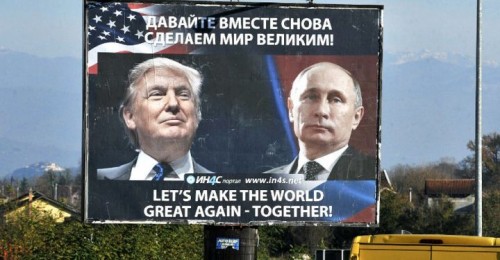
...along with Trump, adores Putin and Le debt, er, Le Pen.
Active Measures is playing the right populist card across The US and Europe and The Alt Right is distributing their propaganda enthusiastically.
Vincent Law, another one coming from a perspective down on Britain, while fancying an expansive bridge between Germany and Russia, registers his enthusiasm for Trump, Putin and le Pen in this regard.
Original article, Russia Insider. Translation, Vincent Law.
AltRight, “Russia’s “Alt Right” Ecstatic About Trump”, 17 Feb 2017:
The author is director of the Liberty Institute, a Russian think tank, and a senior official in the Motherland (Rodina) party, a conservative party represented in Russian parliament.
The popularity of the new US president among Russian New Right patriots seems, at first glance, to be something of a paradoxical phenomenon. However it is in fact, a continuation of an old Russian custom. Russians have a tradition of taking foreign ideas concerning politics as their own, adapting them to Russia.
It all started back in the days of Prince Vladimir- (whose historical memory is experiencing a Renaissance in Russia.) Vladimir, for political, economic and military reasons, embraced the faith and order of the neighboring Byzantine Empire, laying the foundation for the future concept of a “Third Rome.” It was Vladimir who carried out large-scale social and political reforms, influenced by ideas taken (this time) from the East.
The next major political and social import came from the West. Peter the Great “opened a window into Europe” as the saying goes when he established the city of St. Petersburg. He immediately began importing Dutch and German culture into Russia.
Soon after, French influence began to influence Russian society. The Russian aristocratic class began to speak almost entirely in French. Even on the eve of the War of 1812, Napoleon Bonaparte enjoyed incredible popularity among the Russian officers that were arrayed against him. What is remarkable is that Napoleon was probably more popular then among Russians than Trump is now. But this did not prevent the Russian people from going out to stop Napoleon’s invasion and eventually going on to march all the way to Paris.
Moving along through history, the Decembrists in 1825 picked up many ideas from the French and American revolutions as a result of their time in the West after the defeat of Napoleon. Liberty, equality and fraternity; the republic and nationalism, populism and aristocracy. They eventually would go on to unsuccessfully lead an officer’s coup in Russia in the name of these principles.
Then of course came the events of 1917. The February Revolution was imbued with the spirit of both the French Revolution and the pathos of the English parliamentary system…even if the end result resembled neither. And the October Socialist Revolution bore the hallmark of German and American ideological strains (old Russian patriots in this case like to focus on the Jewish roots of the Bolshevik movement, but I’m putting that detail aside for now). The theory of the Bolsheviks was imported from Germany (Marx and Engels). And the pace of the public-political movement was borrowed from the United States. Trotsky admired America quite a bit, and believed that the revolution would not have been possible without America’s help.
Many Third Position philosophers in Europe considered the United States and the Soviet Union to be two sides to the same coin. They referred to both entities as “mondialist” (which is similar to the term “globalist” which is more in vogue now.)
In turn, the Russian White Army exiles of the 20s and 30s borrowed many ideas from the European Right. But unlike the Russian Bolsheviks, the Russian White Army exiles never succeeded in bringing reforms to Russia based on these Third Position principles.
Then came Gorbachev’s perestroika program and Yeltsin’s democratic reforms, where the Western model was imported wholesale to Russia- even if it was never quite fully adopted. During that period, even the Russian opposition youth movements tried to adopt Third Position ideas from the first half of the 20th century.
Therefore, the current Russian fascination with Trump and Le Pen is quite normal for Russia. The American and French populist right-wing alternative movements serve as inspiration for Russian patriots just as previous historical movements have throughout all of Russia’s history. Only now, there is an interesting new element in the relationship. There is a mirror-effect where patriots in the West seem to have taken a great liking to President Putin as well. He seems to be especially popular among the so called “Alternative Right”.
We don’t yet know how Trumpism and Le-Penism will be adapted and adopted in Russia. But now it is clear from Trump’s victory, the potential success of Le Pen, and the rise of Eurosceptic parties all over Europe that things have finally started to go our way. All signals from the West are clear to the Russian New Right. They read: “Alternatives exist & victory is possible.”
“Everything will change, right here and right now” – Trump said in his inaugural speech. He was speaking to the American people, but his message was heard loud and clear in Russia as well. To everyone in Russia, in whose veins “flows the red blood of patriots,” a new day has come.
The Alternative Right everywhere is ablaze with excitement at Trump’s victory.






 Avramopoulos








 Original article, Russia Insider. Translation, Vincent Law.